Food & Beverage
Global Snack Brand: Moving Holiday Marketing from a Campaign to a Product Innovation System with GEA
An international snack brand restructured its new product development with product innovation GEA, using AI to simulate consumer decision-making, significantly shortening the development cycle, increasing the number of innovations by 6 times, and reducing the testing cycle by 80%.
Category
Food & Beverage
Date
2026-04-29
Read Time
5 min read
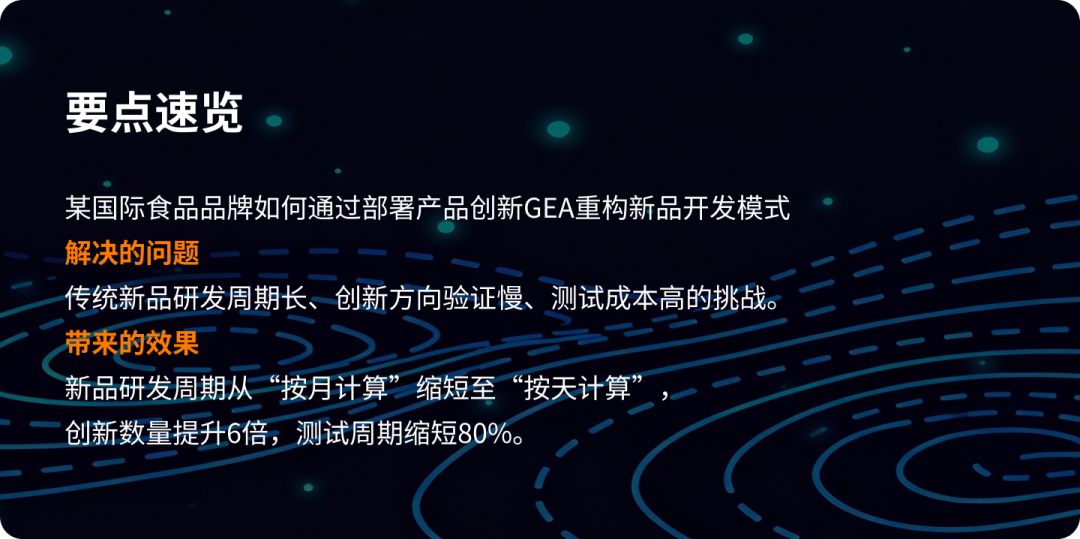
In the fast-moving consumer goods industry, companies often believe they are addressing the issue of insufficient holiday new product creativity. However, the real problem is not the quantity of ideas, but rather the lack of an innovative operational mechanism that can continuously understand consumer emotional structures, gifting contexts, and cultural expression pathways.
When new product directions rely on repeated interviews, research, or creative meetings, innovation capabilities essentially remain at the project level rather than the system level. This is precisely where product innovation GEA enters the company's R&D process.
Companies are beginning to realize that what is truly needed for new product innovation is not more ideas, but a sustainable consumer co-creation system.
Limitations of Traditional Research Systems: Companies Can See Behavior but Struggle to Understand Motivation
Holiday consumption scenarios are highly complex: they encompass functional needs as well as relational expressions; they involve gifting identities and emotional transmissions; they are influenced by cultural symbols and social communication contexts.
Traditional new product processes typically rely on: internal creative meetings, qualitative user interviews, focus group testing, and pre-launch validation research. The issue with these methods lies not in their quality, but in their operational approach:
They are one-time events rather than ongoing processes;
They produce report-type outputs rather than reasoning-type systems;
They validate ideas but cannot generate innovative structures.
What companies truly lack is not the voice of the user, but an innovative mechanism that can continuously simulate the consumer decision-making process.
In this project, the company deployed product innovation GEA, upgrading the holiday new product development from an “expert review-driven process” to a “consumer participation-driven process”. Innovation no longer starts from internal assumptions but continuously generates possibilities from the consumer emotional structure. For the first time, product innovation became a sustainable system capability.
Step One: Build Research Context to Make Historical Research a Callable Asset for Agents
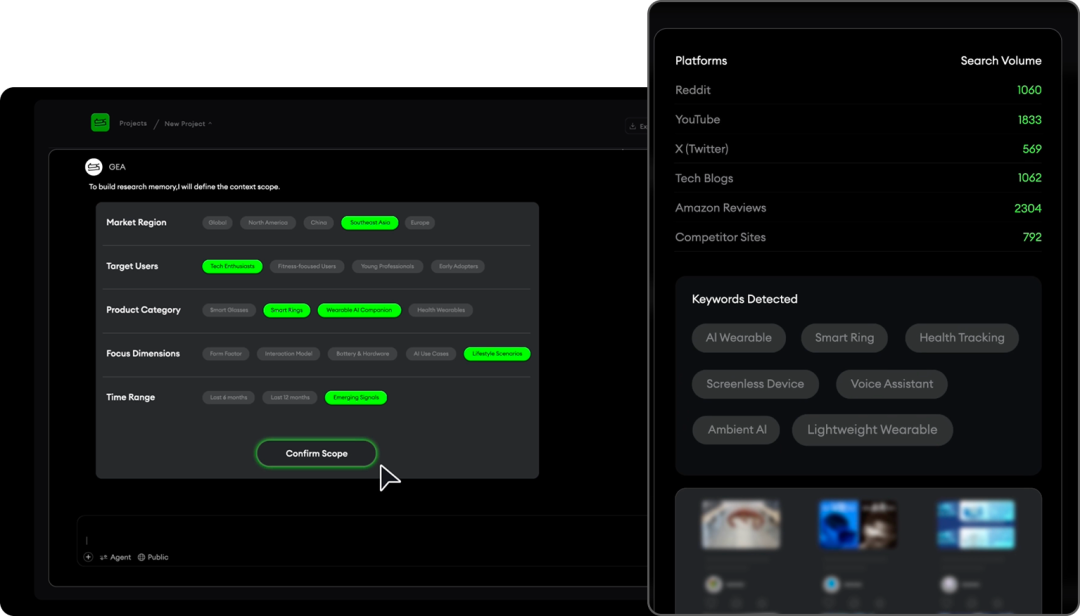
The system first constructs the enterprise context system necessary for holiday innovation, including: historical performance data of holiday new products, consumption structure of gifting contexts, packaging visual expression experiences, cultural symbol usage pathways, and brand language expression patterns.
This information, originally scattered across reports, materials, and experiences, is structured into a unified Context System. For the first time, the company formed a computable, inferable, and reusable consumer emotional knowledge structure, allowing holiday innovation to no longer rely on experiential judgment but to operate continuously based on context.
Step Two: Generate a Consumer Decision-Making Subject Structure That Can Participate in the Innovation Process
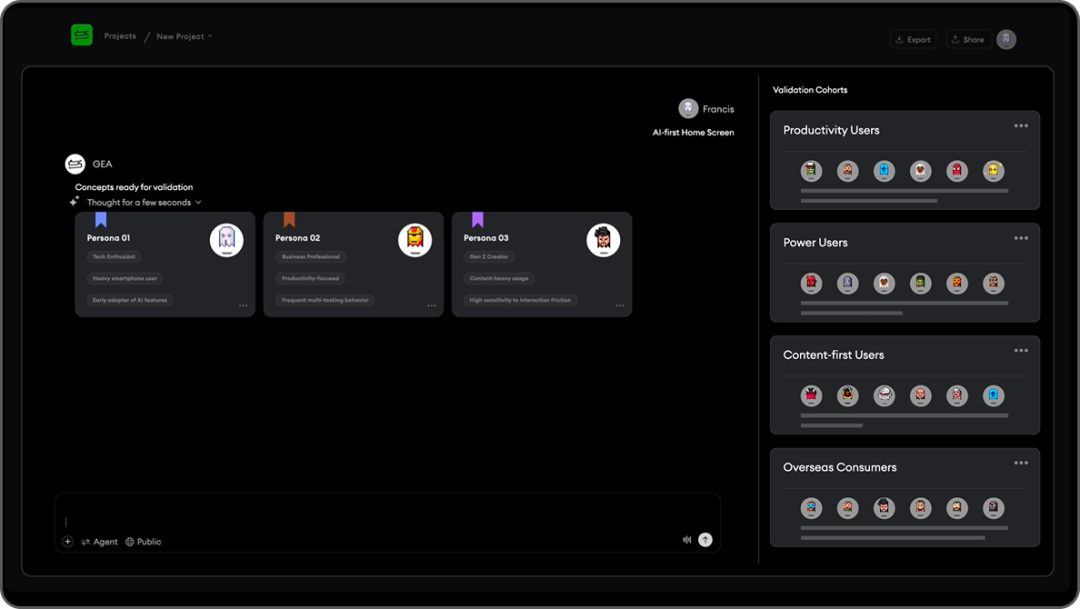
Based on the context system, the system constructs multi-role AI Personas for holiday consumption scenarios, including:
Relationship expression role
Budget judgment role
Family decision-making role
Social sharing role
These Personas are no longer traditional user profiles but complete decision-making subjects. They can simulate how real consumers express themselves, make judgments, and choose in holiday contexts, allowing companies to observe how consumers understand products during the new product design phase rather than waiting for market feedback after launch.
Step Three: Simulate Real Decision-Making Processes to Understand How Users Make Choices, Not Just How They Express Choices
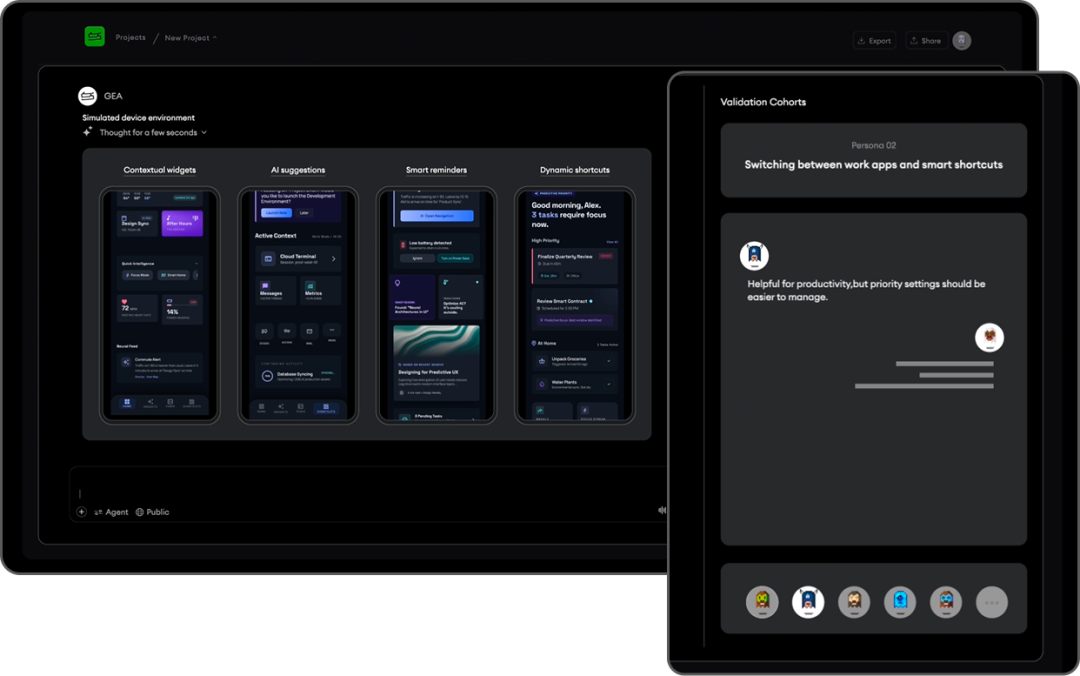
Based on the Persona system, product innovation GEA further constructs a continuously operating consumer discussion mechanism:
AI Interview simulates real interview expression paths
AI Panel simulates group discussion processes
Multi-role co-creation meetings simulate family internal decision-making structures
Companies can continuously test around new product concepts:
Packaging emotional acceptance
Understanding of holiday expression methods
Taste association pathways
Gifting relationship adaptation levels
This simulation mechanism allows consumer participation to occur during the product definition phase rather than after launch. As a result, the direction of innovation gains greater certainty.
Step Four: Form a System of Innovation Capabilities That Continuously Generates Holiday New Product Concepts
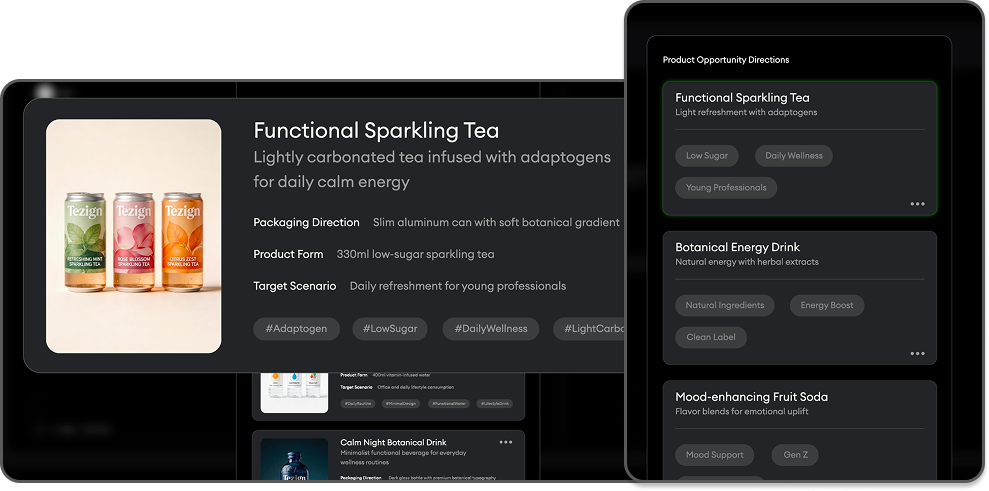
Supported by the context system and Persona reasoning structure, the system can continuously generate a new product concept library around key nodes like the Lunar New Year and screen and validate different innovation pathways.
New product innovation no longer relies on one-time research but becomes a continuous operational process:
Continuously observing changes in consumer expression
Continuously generating holiday product directions
Continuously screening high-potential concept pathways
Continuously optimizing innovation judgment structures
Product innovation has upgraded from a one-time task to a long-term operational capability.
Project Results: From New Product Validation Projects to Enterprise-Level Innovation Capability Assets
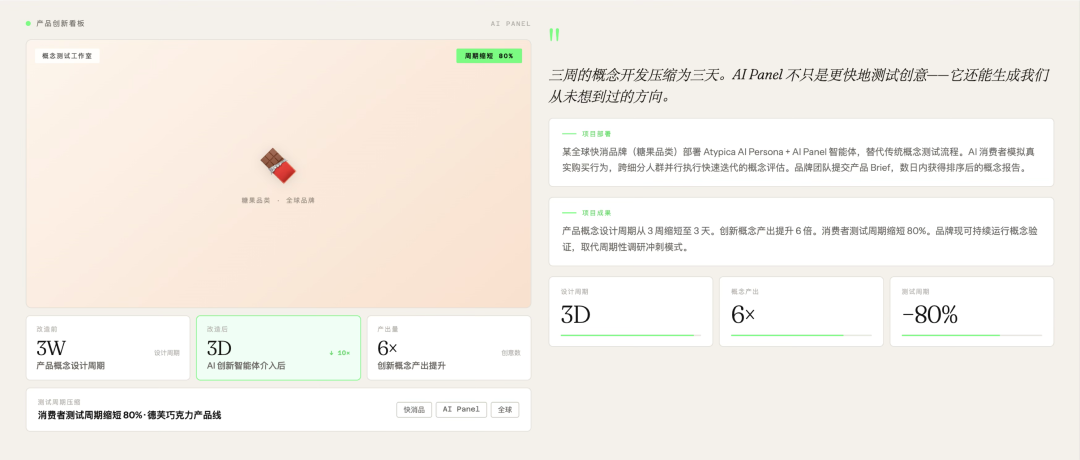
Through the deployment of product innovation GEA, the company achieved significant business changes: the new product development cycle was shortened from monthly to daily, the number of new products developed increased by 6 times, and the new product testing cycle was reduced by 80%.
More importantly, consumer understanding entered the product definition phase for the first time, rather than remaining in the post-launch validation phase. These judgments did not disappear with the end of the project but were solidified into an asset of holiday consumption innovation capabilities that the company can continuously draw upon, allowing new product development to gradually form a reusable innovation infrastructure.
Product Innovation Capability Becomes a Sustainable System Capability for the First Time
In the past, holiday new product innovation relied on expert experience; later, it relied on research reports; now, it begins to rely on a continuously operating consumer reasoning system. What product innovation GEA changes is not just the efficiency of launching a new product, but the way companies understand consumer emotional structures.
It is not about helping companies complete a new product design task faster, but about making “consumer co-creation of product innovation capabilities” a sustainable system capability for the first time.
Category
Food & Beverage
Date
2026-04-29
Read Time
5 min read
Related Recommendations

Global Fashion Group: Scaling Creative Excellence Beyond Individual Talent
Multinational Food Company: Giving Product Innovation a Memory