All
How can the Context System be effectively utilized by Agents? The key lies in this technical design
The Context System is the enterprise knowledge supply infrastructure of Tezign GEA, relying on a five-path parallel recall mechanism to address the shortcomings of Agent reasoning that lacks corporate context. It ensures precise adaptation of AI creation to corporate assets and standards through permission awareness and continuous state design.
Category
All
Date
2026-08-06
Read Time
7 min read
Technical positioning of this article:The Context System introduced in this article is the foundational infrastructure layer specifically responsible for "enterprise knowledge supply" within the core technology system of Tezign GEA. The reasoning quality of the GEA system depends on how accurately and completely the Context System can provide corporate context during operation. Understanding this technology is a key step in understanding "why GEA becomes more knowledgeable about this company the more it is used."
Many companies encounter a problem during the deployment of Agents: the Agent can perform tasks but does not understand the company.
It is not a failure of tool invocation, nor is it due to insufficient model capability. It is that the Agent lacks sufficient context during reasoning to make judgments that are "in line with this company"—it knows how to generate content but does not know what the brand tone of this company is, which expressions are prohibited, what materials have been used in similar projects historically, and what the preference structure of the target consumers is. Each time a task begins, the Agent is essentially unaware of this company.
This is not a problem that can be solved by prompts. The amount of context that prompts can convey is far less than the asset scale accumulated by a brand that has been operating for over ten years. This client's content library exceeds 800,000 items, spanning multiple product lines, markets, and years of visual language evolution. The Agent needs to access these assets in real-time during the task reasoning process and accurately inject relevant context into the reasoning chain—something that no existing system can achieve.
Therefore, we established the Context System. It is one of the core technologies of Tezign GEA, specifically responsible for solving the problem of "lack of corporate context during Agent reasoning." It is not an independent retrieval tool but rather the infrastructure layer that connects corporate knowledge assets with the Agent reasoning chain within the GEA architecture—SWM understands consumers, CRM orchestrates divergent reasoning, while the Context System determines what these two models can "see" during reasoning. Without it, the Agent's capability ceiling is determined by the length of the prompts; with it, the Agent's capability ceiling is determined by the depth of the corporate accumulated assets.
Runtime context requirements for Agents
The context demand pattern of an Agent executing content tasks is fundamentally different from human retrieval behavior.
Humans typically perform "one-time retrieval"—inputting keywords, browsing results, and relying on their judgment to filter and combine. However, the Agent performs "multi-round cascading retrieval" within a single task: first recalling brand specifications, then matching historical similar materials based on the content of the brand specifications, and finally confirming compliance constraints for that market based on the characteristics of the materials. Each round of retrieval relies on the results of the previous round and must be completed within the reasoning waiting window—usually on the order of hundreds of milliseconds. The results must be sufficiently precise because the Agent does not make secondary judgments among dozens of results like a human; retrieval errors propagate down the reasoning chain.
The more fundamental issue is the information density of the content. Most of the useful information in brand content assets is not in text labels—a photo's visual emotion, brand consistency, and visual resonance with the target audience cannot be fully described with labels. Traditional text retrieval has a natural precision limit for such assets—an Agent that needs to recall the 10 most relevant items from 800,000 materials relying solely on text matching means that a large number of useful assets will not be retrieved, and the Agent ultimately reasons on missing context.
This means the Agent needs a fundamentally different context supply method: not single keyword matching, but a runtime cognitive foundation with multi-path semantic parallelism. This is the design starting point of the Context System.
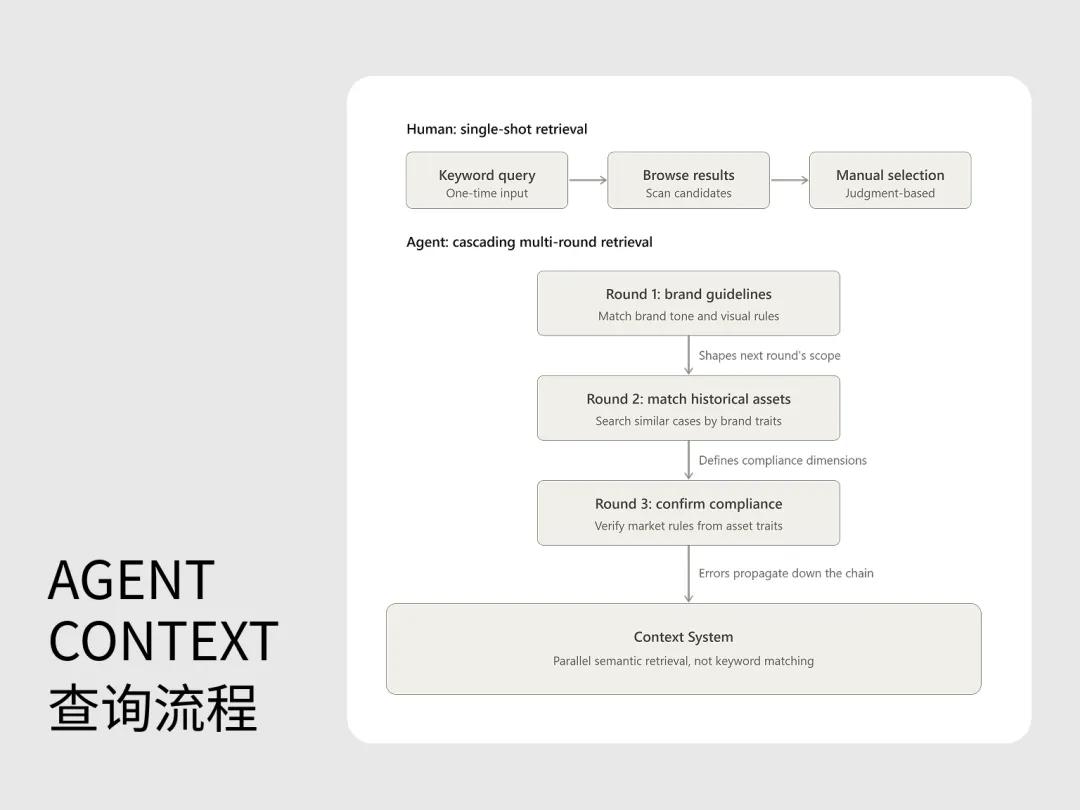
Architecture of the Context System
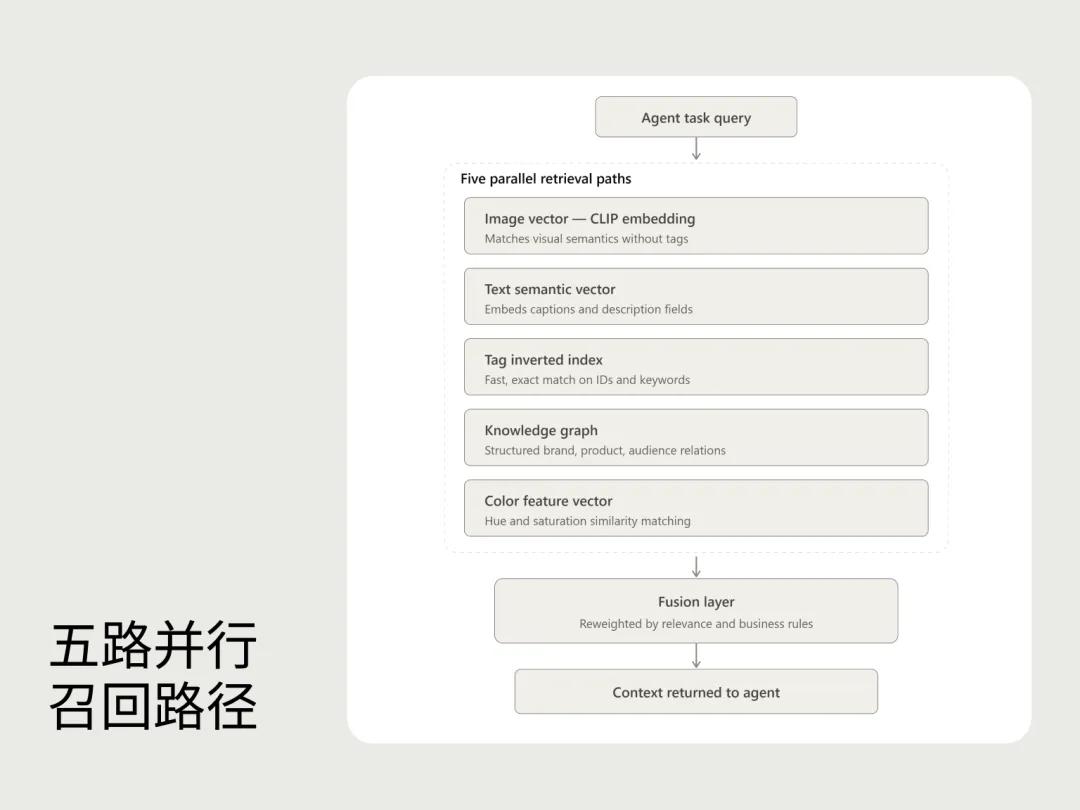
We define the Context System as the runtime cognitive foundation for Agents: the Agent retrieves context from here when executing tasks, rather than reasoning from scratch each time.
The core is five-path parallel recall, rather than single text matching:
Image content vectors: Transform images into high-dimensional vectors using a visual encoder (CLIP). When the Agent needs semantics like "sunny outdoor women," it does not rely on text labels but directly performs similarity matching in vector space.
Text semantic vectors: Vectorize labeled text and description fields, processing assets with complete textual descriptions, complementing image vectors.
Tag inverted index: Handle deterministic queries—asset numbers, project names, specific keywords. This path is fast and precise, suitable for when the Agent needs to recall specific known assets.
Knowledge graph: Store structured relationships between brands, products, scenarios, and audiences. When the Agent needs to handle tasks like "XX product targeting the European market Q3 launch," the knowledge graph can understand entity associations and narrow the retrieval scope to the correct context set.
Visual color features: Extract the main color tone and color histogram from each image, constructing indexable color feature vectors. This turns "filtering out portrait materials with the main tone of brand blue" into a computable condition—matching in vector space based on hue and saturation weighted distances, rather than relying on manual post-verification.
After five-path parallel recall, the fusion layer reorders by relevance scores and business rules, returning the context needed by the Agent. Compared to single text searches, mixed recall significantly improves accuracy in corporate image retrieval tasks—image vectors capture visual semantics, knowledge graphs understand entity associations, and color features constrain brand consistency, each path solving a dimension that text labels cannot cover.
Two architectural constraints make the Context System truly usable
Making this system usable for Agents is most challenging not in algorithms, but in two architectural constraints.
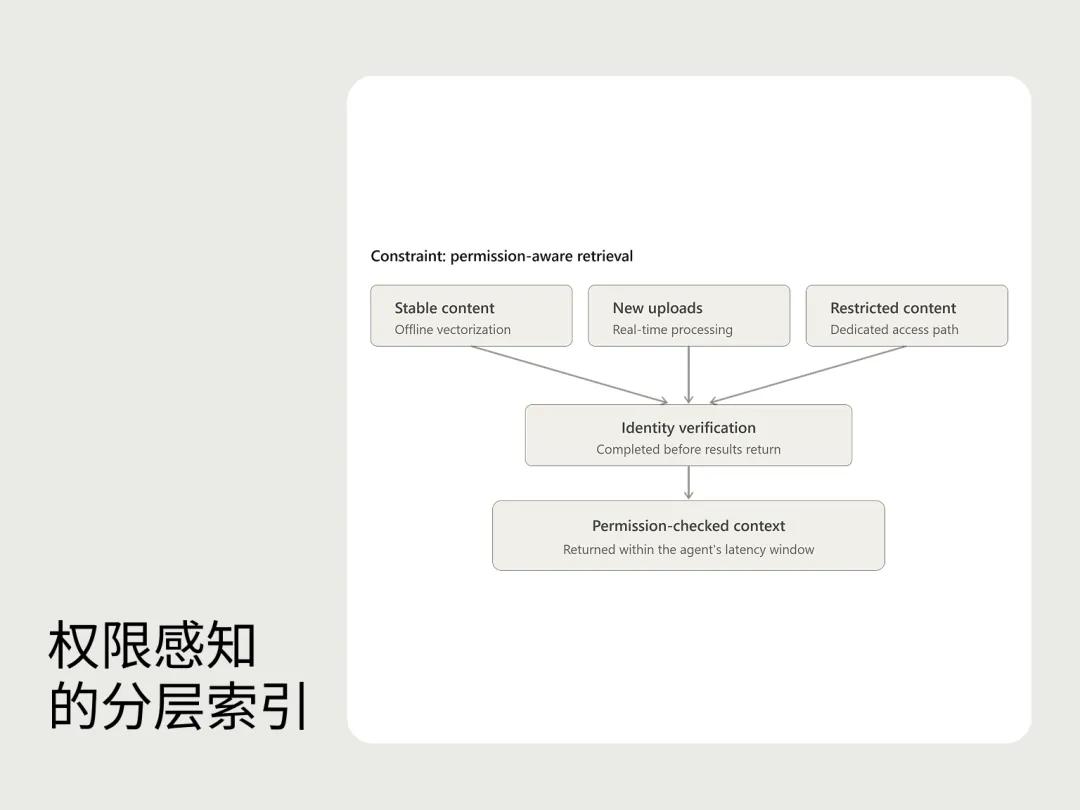
The first is permission awareness. Corporate content assets have strict permission controls—what materials are visible to which teams, what is under review, and what has been taken offline. The execution identity of the Agent for different tasks varies, and the visible context range also differs. This means that not all vectors can be placed in a global pool; permission verification must be completed before results are returned, rather than filtering after the query is completed (which would exceed the Agent's waiting window).
Our solution is hierarchical indexing: stable authorized content is vectorized offline, newly uploaded assets are processed online in real-time, and restricted content goes through an independent permission pipeline, completing identity verification before recall.
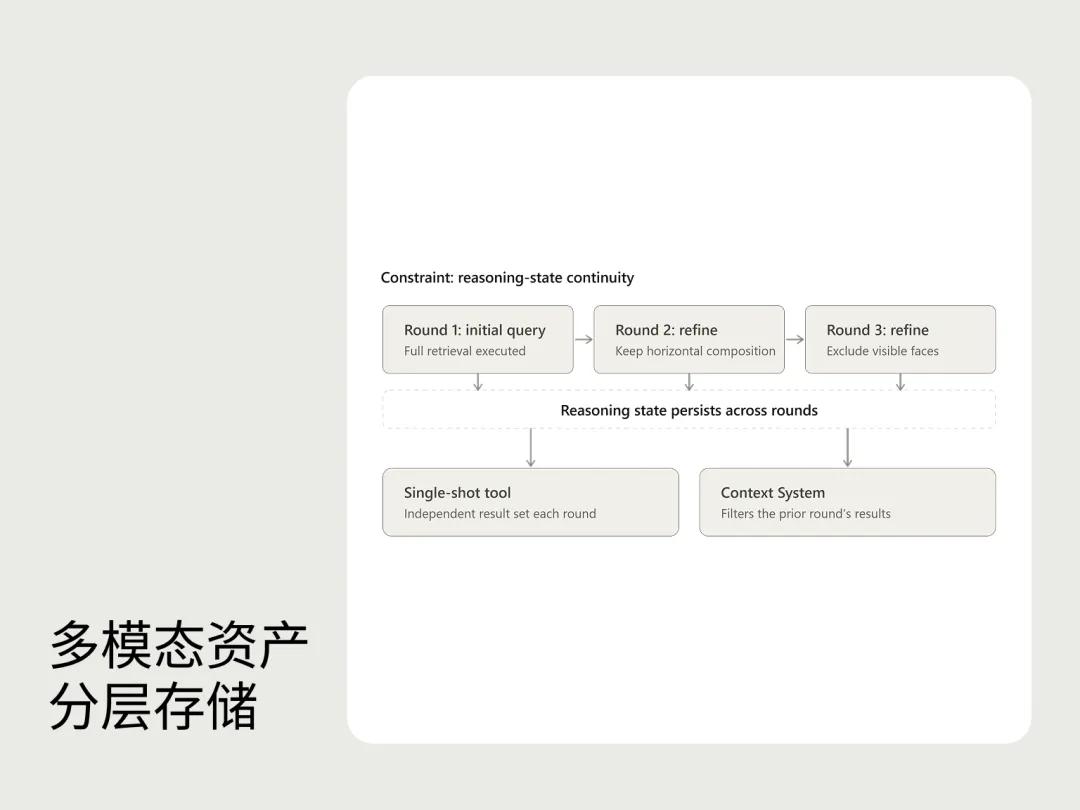
The second is reasoning state continuity. The Agent needs multi-round retrieval when handling complex tasks, and each round of retrieval depends on the reasoning results of the previous steps—"in this batch of results, only horizontal compositions" or "exclude those with faces." The system must maintain the reasoning context, understanding incremental instructions as filtering of the previous results rather than restarting the entire process.
Maintaining state during the reasoning process is the fundamental architectural difference between the Agent's native context system and single retrieval tools. A single query yields an independent result set; the Context System needs to understand the semantics of "further constraining based on the previous round of results," linking multi-round retrieval into continuous reasoning steps.
A key takeaway
The core problem solved by the Context System is the lack of corporate context during Agent reasoning. It does not replace the existing content management systems of enterprises but builds a runtime context layer for Agent reasoning on top of them—allowing the Agent to know who this company is, what language it uses, and what assets it has when executing tasks.
An enterprise's content Agent capabilities in the AI era largely depend on the quality of the Context System—it is the starting point for Agent reasoning. With it, the Agent does not make judgments without knowing anything about this company.
References
Radford, A., Kim, J. W., Hallacy, C., et al., 2021. Learning Transferable Visual Models From Natural Language Supervision. ICML 2021, PMLR 139:8748-8763.
Riedler, M. & Langer, S., 2024. Beyond Text: Optimizing RAG with Multimodal Inputs for Industrial Applications. arXiv:2410.21943.
Category
All
Date
2026-08-06
Read Time
7 min read
Related Recommendations

Divergent Reasoning Model: Exploration, Evaluation, and Convergence

How is a Knowledge Graph with Millions of Nodes Built?