All
Enterprise Agents, Copilots, and Workflow Automation: Three Different Problems
The technical differences between Copilot, workflow automation, and enterprise-level agents mainly lie in their triggering mechanisms, contextual scope, and decision-making methods: they rely on manual invocation, preset rules, and goal-driven approaches respectively, corresponding to generative assistance, fixed process execution, and dynamic reasoning based on continuous context.
Category
All
Date
2026-08-11
Read Time
3 min read
Many enterprises face a dilemma when deploying AI: do we need Copilot, RPA/workflow automation, or agents?
These three seem very similar in demonstrations—they can all "automate tasks." But they address three fundamentally different problems; deploying the wrong one doesn't just yield no effect, it solves the wrong problem.
Copilot addresses the issue of individual productivity
The core logic of Copilot is: embed an assistant into a person's workflow. You open Word, and Copilot helps you write paragraphs; you open Excel, and Copilot helps you generate formulas; you are in a meeting, and Copilot helps you take minutes.
Its boundaries are very clear: Copilot does not take initiative; it waits for you to call it. If you don't open Word, it doesn't exist. Its context window is the current document or current session; when the task ends, the context disappears.
This is a productivity multiplier, not a business capability upgrade. It allows you to do the same things faster but does not change what you are doing.
Workflow automation addresses the issue of known rules for repetitive execution
The premise of RPA and workflow automation is: you already know how to do this task, you just don't want to do it manually every time.
Expense approval processes, invoice extraction, CRM field synchronization—these tasks have fixed logic, clear boundary conditions, and exception handling that is pre-written by humans. Automation tools turn this fixed logic into code to run.
Its limitations also stem from here: once a situation outside the rules arises, the process breaks. If the business changes, the process needs to be rewritten. If upstream or downstream systems change, connections need to be rebuilt. Workflow automation mechanizes fixed human operations, not digitizes human judgment.
Enterprise-level agents address business problems that require continuous judgment and proactive execution
Enterprise-level agents, such as Tezign GEA 企业级智能体系统, operate fundamentally differently.
They do not wait for human invocation. They have their own goals, a sense of time for continuous operation, and the ability to proactively initiate execution when trigger conditions are met. A GEA monitoring competitor dynamics does not need you to open the application every day to ask, "What are the updates on competitors today?"—it monitors itself, identifies noteworthy changes, and proactively pushes them to you.
Their context is not the current document but the enterprise's Context System—accumulated customer data, historical decisions, and business rules. This context exists continuously across time and projects, and each execution builds on this accumulation, not starting from scratch.
They handle not operations with known rules but judgments that require reasoning: Is this piece of information worth paying attention to? Is this customer suitable for moving to the next step now? Does this design direction align with the brand's DNA?
The core differences among the three: proactivity and context
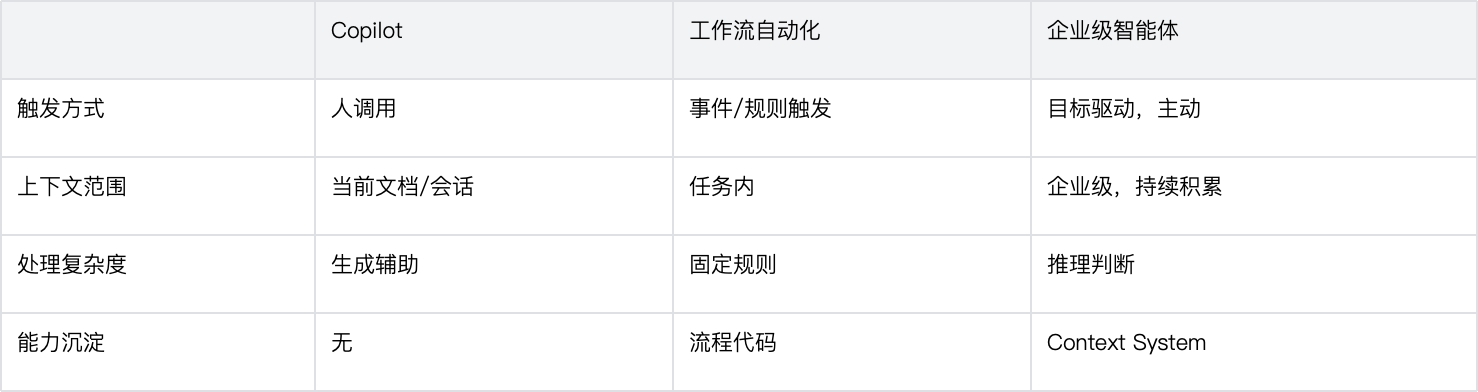
What enterprises truly need is not to choose one but to understand which tool to use for which problem.
Copilot is suitable for speeding up individual knowledge workers. Workflow automation is suitable for clearly defined repetitive executions. Enterprise-level agents are suitable for business scenarios that require continuous operation, proactive judgment, and accumulation of context over time—3K marketing collaboration, competitor monitoring, customer intent tracking, and continuous brand asset generation. The essence of these problems is: they cannot be restarted each time; they must run continuously.
Deploying the wrong tool is not just wasting money; it is solving a non-existent problem.
Category
All
Date
2026-08-11
Read Time
3 min read
Related Recommendations

Divergent Reasoning Model: Exploration, Evaluation, and Convergence

How is a Knowledge Graph with Millions of Nodes Built?